
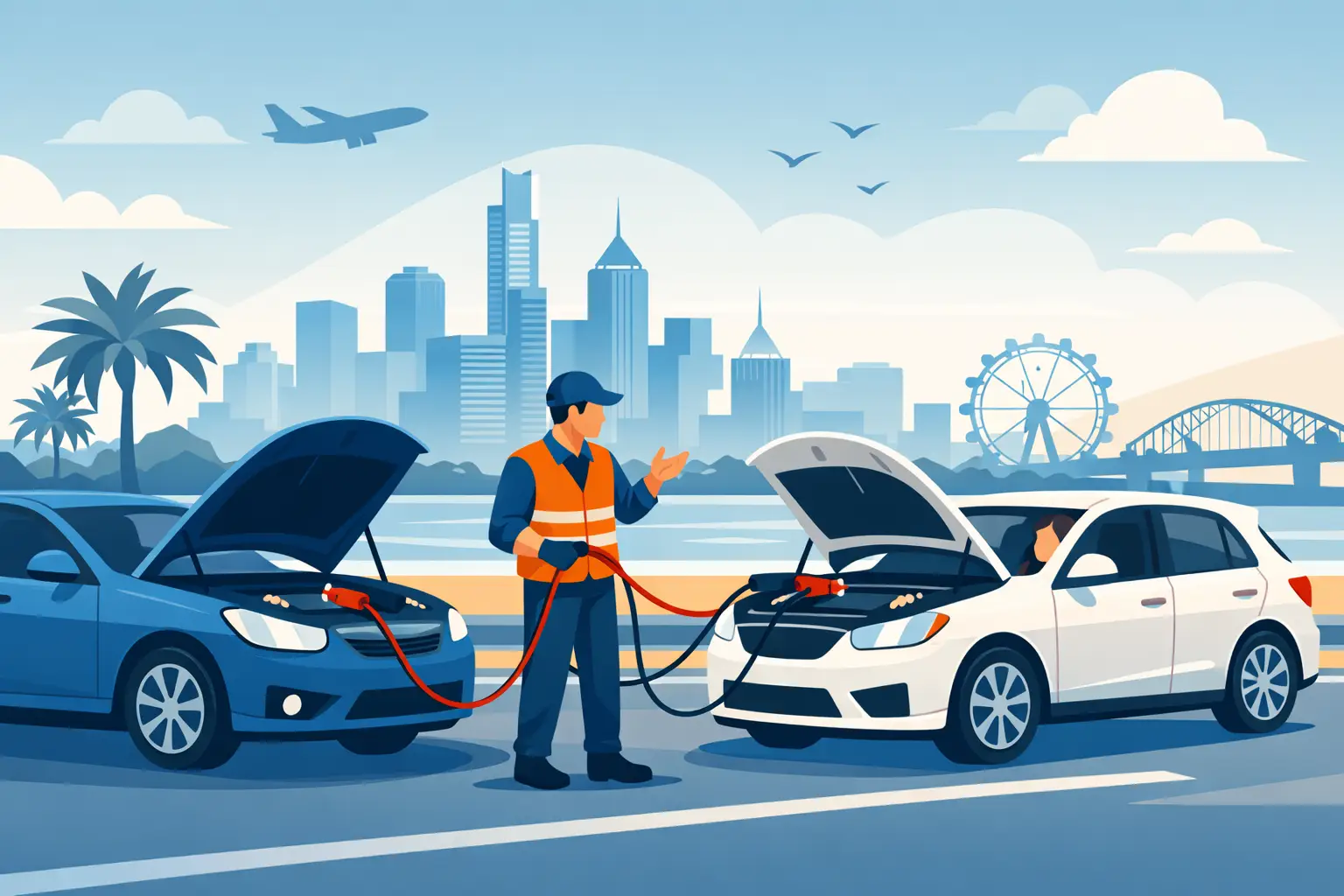
A flat battery can turn an ordinary trip to work, school pickup or a job site into a frustrating stop. Knowing how to get jump-started safely can get you moving again, but only when the battery is the real problem and the vehicle can be started without putting you or anyone nearby at risk.
Before reaching for jumper leads, get the car somewhere safe if possible. Put the vehicle in park or neutral, apply the handbrake, turn off the ignition and keep clear of passing traffic. If you are stopped on a busy Melbourne road, near a blind corner or in an unsafe location, roadside help is usually the better call.
First, check whether a jump-start is suitable
A jump-start is designed for a flat 12-volt battery. Common signs include a slow crank, clicking when you turn the key, dim dashboard lights, or no response when you press the start button. Leaving interior lights on, short trips, cold mornings and an ageing battery can all leave a car without enough charge to start.
It will not fix every no-start issue. If the engine turns over normally but will not fire, the cause may be fuel, ignition, immobiliser or mechanical trouble. If there is smoke, a burning smell, leaking fluid, a badly damaged battery case or a swollen battery, do not attempt a jump-start. Step away from the vehicle and arrange assistance.
You should also avoid jump-starting a car if the battery has frozen. This can happen in very cold conditions and, while uncommon around Melbourne, a frozen battery can crack or explode during charging. Check the owner’s manual if you have a hybrid, electric vehicle, European vehicle, or a car with battery terminals located somewhere other than under the bonnet. Many vehicles have designated jump points, and using the wrong connection can cause expensive electrical damage.
What you need to get jump-started
You need a working 12-volt donor vehicle and good-quality jumper leads, or a suitable portable jump starter. Both vehicles must use a 12-volt system. Never use a 24-volt truck, bus or commercial vehicle to jump-start a standard passenger car.
Park the donor vehicle close enough for the leads to reach, but make sure the vehicles are not touching. Switch off both ignitions, lights, air-conditioning, radios and accessories. Keep loose clothing, jewellery and tools away from the battery area and moving engine parts.
If you are using a portable jump pack, follow its instructions exactly. The connection order and safety features can vary by model. A jump pack is often the easier option because you do not need another car, but it still cannot repair a failed battery or a charging fault.
How to get jump-started with jumper leads
Take your time with the lead connections. Reversing the clamps can damage fuses, wiring and vehicle electronics.
- Connect the red positive clamp to the positive (+) terminal on the flat battery.
- Connect the other red positive clamp to the positive (+) terminal on the donor battery.
- Connect the black negative clamp to the negative (-) terminal on the donor battery.
- Connect the remaining black clamp to a clean, unpainted metal earth point on the disabled car, well away from the battery and fuel system.
Do not attach the final black clamp directly to the flat battery’s negative terminal unless the vehicle manufacturer specifically says to do so. Connecting it to an approved earth point helps reduce the chance of sparks near battery gases.
Start the donor vehicle and let it idle for a few minutes. Do not rev it hard. Then try starting the car with the flat battery. Keep the attempt brief – around five seconds is enough. If it does not start, wait a minute before trying again.
If the car starts, leave both vehicles running for another minute or two before removing the leads. Remove them in the reverse order: black clamp from the revived car, black clamp from the donor vehicle, red clamp from the donor vehicle, then red clamp from the revived car. Make sure the clamps do not touch each other or any metal while they are connected.
If the car still will not start
Do not keep cranking the engine over and over. Repeated attempts can flatten the donor battery, overheat the starter motor and make it harder to identify the real fault.
If the engine only clicks after a correct connection, the battery may be too far gone, a terminal may be loose or corroded, or the starter could be faulty. If it cranks but does not start, a jump-start is unlikely to solve the issue. A roadside technician can assess the vehicle, while a tow truck can move it safely to a mechanic, home or another required location.
A vehicle that starts and then quickly stalls may have an alternator or charging-system problem. In that case, driving farther can leave you stranded again, often in a worse location. It is safer to arrange a tow rather than hoping the battery will hold out.
After the engine starts, do not assume the problem is fixed
Once the car is running, drive it for at least 20 to 30 minutes where safe to do so. Avoid switching the engine off straight away. This may put some charge back into the battery, but a drive is not a guaranteed fix, particularly if the battery is old or the alternator is not charging correctly.
If the battery light stays on while you drive, pull over safely when practical and organise help. That warning light often means the charging system is not working as it should. Also pay attention if the car struggles to restart later that day, the headlights seem weak, or dashboard warnings appear.
A battery test is worthwhile after any jump-start. Most car batteries have a limited service life, commonly around three to five years depending on use, weather and vehicle type. Replacing a weak battery before it fails is generally cheaper and less stressful than being stuck in a car park, driveway or on the side of the road.
When to call for roadside help instead
A jump-start is not always the safest or quickest choice. Call for assistance if you are on a freeway, in heavy traffic, in poor visibility, with children in the vehicle, or in a place where opening the bonnet puts you near moving cars. The same applies if you do not have proper leads, are unsure where the battery terminals are, or suspect an accident-related fault.
For Melbourne drivers, local support matters when you need a vehicle moved quickly after a failed start. Towing VicState can assist with roadside issues and safe towing across the northern suburbs and surrounding areas, including places such as Broadmeadows, Epping, Craigieburn, Preston, Coburg and Sunshine.
A flat battery is inconvenient, but it does not need to become a risky roadside job. If anything looks damaged, smells unusual or simply does not feel right, leave the leads alone and arrange professional help. Getting home safely is more valuable than forcing one more start.