
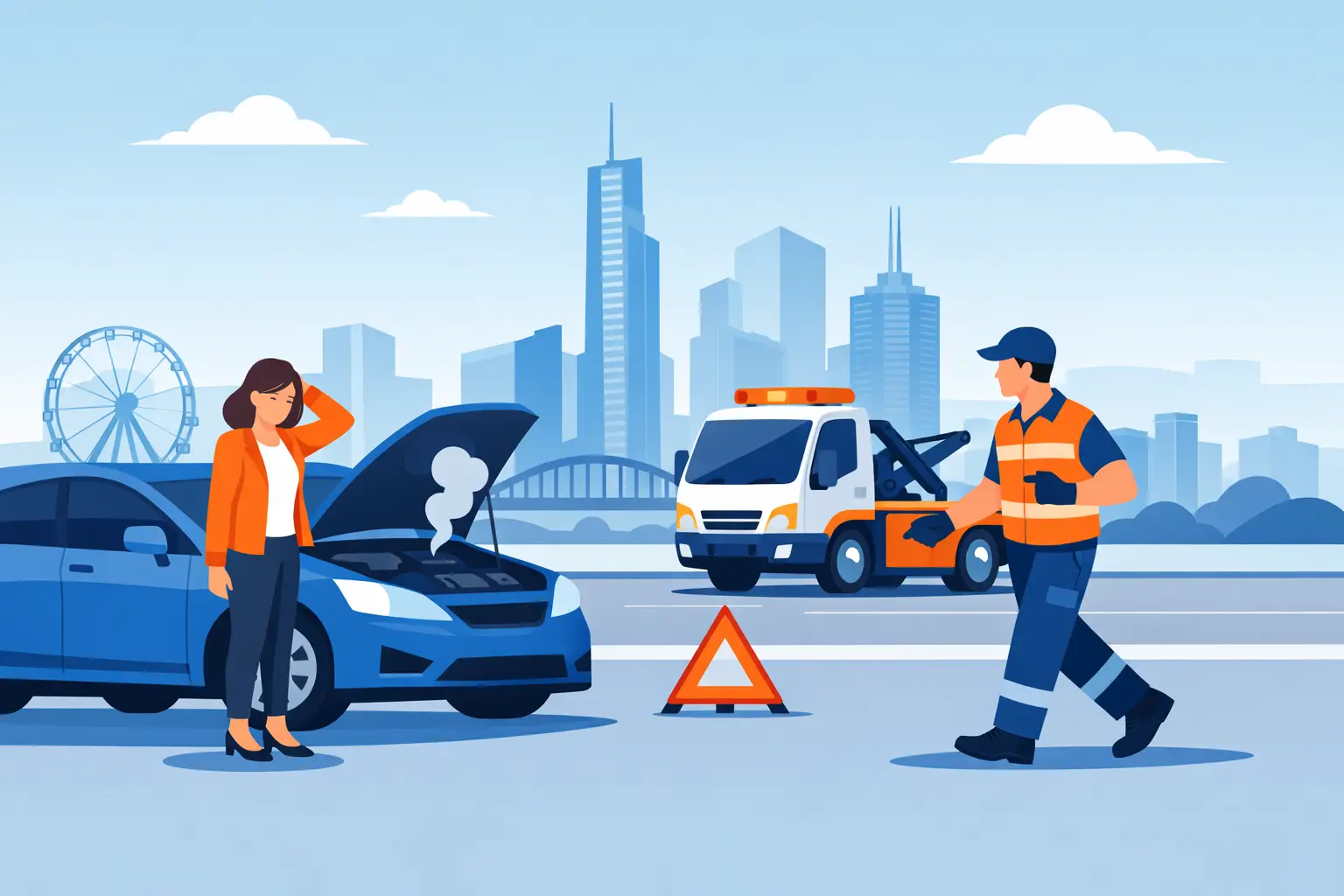
A car that will not start can turn an ordinary trip into a stressful stop, whether you are outside home in Craigieburn, in a car park at Preston, or pulled over near Campbellfield. When you need car won’t start roadside help, the first job is keeping yourself safe. The second is working out whether a simple check may get you moving or whether it is time to arrange roadside assistance or a tow.
Do not keep turning the key or pressing the start button over and over. Repeated attempts can flatten a weak battery, flood some older engines, or make it harder to identify the original problem. Take a breath, secure the car and assess where you are before doing anything else.
Get safe before checking the car
If the vehicle has stopped on a busy road, turn on your hazard lights straight away. If it is safe to do so, move the car clear of traffic. On freeways, major arterial roads, blind corners or narrow streets, staying visible matters more than diagnosing the fault.
Put the car in park or neutral, apply the handbrake and make sure passengers are away from passing traffic. Avoid standing between your vehicle and the road. At night or in poor weather, use a torch or your mobile light rather than trying to inspect the engine bay in the dark.
If you have been in an accident, notice fuel leaking, smell smoke, or see steam coming from under the bonnet, do not try to restart the vehicle. Move to a safe position where possible and organise professional recovery. A damaged vehicle may need tilt-tray or flatbed transport to avoid further damage.
Common reasons a car will not start
The way your car behaves when you try to start it gives a useful clue. It does not always tell you exactly what has failed, but it helps decide whether a basic roadside check is sensible.
A flat or weak battery
A battery issue is one of the most common causes. You may hear rapid clicking, see dim dashboard lights, or get no response at all when you turn the key. Leaving headlights, an interior light or accessories on can flatten a healthy battery, while cold mornings and an ageing battery can expose an underlying problem.
A jump-start may help if you have the right equipment and know how to use it safely. However, a car that starts after a jump is not necessarily fixed. The battery could be near the end of its life, the terminals may be loose or corroded, or the alternator may not be charging correctly. If the car stalls again or a battery warning light stays on, arrange help rather than hoping it will make the trip.
No crank, one click or a slow crank
A single click can point to a starter motor, starter relay or battery connection issue. A slow crank may be a weak battery, but it can also be caused by poor terminal connections. Check only what you can see safely. If battery terminals look loose, do not touch them with metal tools or attempt makeshift repairs at the roadside.
Modern vehicles can also refuse to start because of an electronic fault. A key fob battery, immobiliser problem or sensor issue can stop an otherwise healthy car from starting. Try your spare key if it is available, and check the owner’s manual for any model-specific starting procedure.
Fuel, overheating or mechanical faults
It sounds obvious, but a low fuel level is worth checking, especially if the car is parked on a slope. Fuel gauges are not always precise, and a vehicle that has run dry may need more than simply adding a small amount of fuel before it will restart.
If the engine turns over normally but will not fire, the cause could involve fuel delivery, ignition or engine management. If warning lights appeared before the breakdown, the engine was running rough, or the car overheated, avoid repeated start attempts. Continuing can turn a repairable issue into a larger mechanical problem.
What you can check without taking risks
A few calm checks are reasonable when you are safely parked. Confirm the car is in park for an automatic, or neutral with the clutch fully pressed for a manual. Switch off accessories such as the air conditioning, radio and chargers, then try once more.
Look at the dashboard for warning messages and note any unusual sounds. Check whether the headlights work and whether the battery terminals appear visibly damaged or heavily corroded. If you have a push-button start, hold the key fob close to the start button or steering column if your vehicle manual advises it.
Do not attempt to push-start a modern automatic car. It can cause damage and is unsafe on public roads. Manual cars can sometimes be bump-started, but only in controlled conditions with experienced help, a safe open area and no traffic risk. For most stranded motorists, calling for assistance is the safer option.
When to call for car won’t start roadside help
Roadside assistance is the right choice when the problem may be resolved on the spot, such as a flat battery, a simple connection issue, a flat tyre or minor lockout situation. If the vehicle can be safely started and appears roadworthy, you may be able to continue your trip after the issue is addressed.
Towing is usually the better option when the cause is unknown, the vehicle has warning lights or mechanical symptoms, it has been involved in a collision, or it starts but cannot be driven safely. A tow also makes sense if you are in an unsafe location, it is late at night, or you simply do not want to risk a second breakdown on the way to a mechanic.
The right transport method depends on the vehicle and condition. Standard towing may suit some breakdowns, while low vehicles, prestige cars, accident-damaged cars, all-wheel drives and vehicles that cannot roll often need a tilt-tray or flatbed. Giving clear details when you call helps send the right truck from the start.
Information that helps get assistance faster
When arranging help, tell the operator your exact location or nearest cross street, the make and model of the vehicle, and what happens when you try to start it. Mention whether the car is in a driveway, underground car park, shopping centre, roadside bay or an active traffic lane.
It also helps to explain if the wheels are locked, the vehicle is in park, it has accident damage, or it is unusually low or heavy. If you need transport, have the mechanic or destination address ready. Clear information allows the tow truck driver to prepare for the job and avoids delays once they arrive.
Towing VicState assists motorists across Melbourne’s northern suburbs and nearby areas, including Broadmeadows, Epping, Coburg, Sunshine and St Albans. Local knowledge can make a real difference when access is tight, traffic is building, or a vehicle needs to be collected outside normal hours.
Avoid making the breakdown worse
The pressure to get home, get to work or collect the kids can make any quick fix look tempting. Avoid pouring water into an overheated engine, disconnecting electrical components without experience, or driving with serious warning lights just because the engine eventually starts.
Likewise, be cautious with a jump-start. Use suitable leads, follow the vehicle instructions and never connect cables if the battery is cracked, leaking or swollen. If you are unsure, wait for trained roadside help. The cost of a safe call-out is often far less than the cost of damaged electronics, a failed engine or an accident.
Keep your phone charged where possible, carry basic emergency items and have a plan for your regular routes. But when your car will not start, there is no prize for solving every fault at the kerb. A safe recovery and proper inspection can get you back on the road with far less stress.